Changing Patterns Over Time Clearly Demonstrate That Marriage, Family, and Kinship Are
Marriage, as a social institution, has been around for thousands of years.1 With things that are thousands of years old, it'southward easy to presume that they can merely change slowly. But developments since the heart of the 20th century show that this supposition is incorrect: in many countries marriages are condign less common, people are marrying later, unmarried couples are increasingly choosing to live together, and in many countries we are seeing a 'decoupling' of parenthood and wedlock. Within the last decades the institution of marriage has changed more than in thousands of years earlier.
Here nosotros present the data behind these fast and widespread changes, and hash out some of the main drivers behind them.
Marriages are becoming less common
In many countries marriage rates are declining
The proportion of people who are getting married is going downwards in many countries across the world.
The chart here shows this trend for a selection of countries. It combines data from multiple sources, including statistical country offices and reports from the Un, Eurostat and the OECD. You can change the option of countries using the selection Add country straight in the interactive nautical chart.
Union rates in the US over the terminal century
For the US we have information on spousal relationship rates going back to the start of the 20th century. This lets united states of america come across when the refuse started, and trace the influence of social and economical changes during the process.
- In 1920, shortly afterwards the Showtime World War, in that location were 12 marriages annually for every 1,000 people in the US. Marriages in the Usa and so were almost twice equally common every bit today.
- In the 1930s, during the Bully Depression, the rate fell sharply. In the 1930s marriages became again more common and in 1946 – the year after the Second Earth War concluded – marriages reached a pinnacle of sixteen.4 marriages per 1,000 people.
- Marriage rates fell again in the 1950s and and then bounced dorsum in the 1960s.
- The long turn down started in the 1970s. Since 1972, matrimony rates in the Us have fallen past almost 50%, and are currently at the everyman betoken in recorded history.
How did marriage rates change around the world?
The chart likewise shows that in comparison to other rich countries, the US has had especially high historical marriage rates. Simply in terms of changes over fourth dimension, the trend looks similar for other rich countries. The Britain and Commonwealth of australia, for example, have as well seen wedlock rates failing for decades, and are currently at the lowest point in recorded history.
For not-rich countries the data is sparse, simply available estimates from Latin America, Africa and Asia suggest that the decline of marriages is not exclusive to rich countries. Over the flow 1990 – 2010 there was a decline in marriage rates in the bulk of countries around the globe.
Just there's however a lot of cantankerous-country variation around this full general trend, and in some countries changes are going in the opposite direction. In Mainland china, Russia and Bangladesh, for example, marriages are more mutual today than a couple of decades ago.
In many countries there has been a large decline in marriages across cohorts
This chart looks at the change in marriages from a different bending and answers the question: How likely were people in different generations to exist married by a given age?
In many rich countries there are statistical records going back several generations, allowing us to judge union rates past age and year of birth. The chart here uses those records to give marriage rates by age and year of birth for five cohorts of men in England and Wales.
For instance, you lot can wait at thirty-yr-olds, and encounter what percent of them in each cohort was married. Of those men who were born in 1940, about 83% were married by age 30. Among those born in 1980 but about 25% were married by age 30.
The trend is stark. English men in more than recent cohorts are much less likely to have married, and that's true at all ages.
There are two causes for this: an increasing share of people in younger cohorts are not getting married; and younger cohorts are increasingly choosing to marry later in life. We explore this second betoken below.
Average age at matrimony
People are marrying later
In many countries, declining spousal relationship rates accept been accompanied by an increment in the age at which people are getting married. This is shown in the chart here, where we plot the average age of women at first union.3
The increase in the historic period at which people are getting married is stronger in richer countries, particularly in North America and Europe. In Sweden, for example, the average age of wedlock for women went upward from 28 in 1990 to 34 years in 2017.
In Bangladesh and several countries in sub-Saharan Africa, the boilerplate age at marriage is low and has remained unchanged for several years. In Niger, where child matrimony is common, the average age at marriage for women has remained constant, at 17 years, since the early 1990s. (NB. You find child marriage data in our interactive chart here ).
Simply these countries are the exceptions. The age at which women marry is increasing in many countries in all regions, from Kingdom of norway to Japan to Chile.
More people marrying later ways that a greater share of young people existence unmarried.
According to the British demography of 1971 about 85% of women between the historic period of 25 and 29 were married, equally this chart shows. By 2011 that effigy had declined to 58%.
For older people the trend is reversed – the share of older women who never got married is failing. In the 1971 census the share of women sixty-64 who had always been married was lower than it is for women in that age-bracket in the decades since.
You lot tin can create like charts for both men and women across all countries, using the UN World Marriage Information site hither. This lets you explore in more detail the distribution of marriages past age across time, for both men and women.
There has been a 'decoupling' of parenthood and marriage
An arrangement where two or more people are not married but live together is referred to equally cohabitation. In recent decades cohabitation has become increasingly mutual effectually the world. In the US, for case, the US Demography Bureau estimates that the share of young adults between the historic period of 18 and 24 living with an unmarried partner went upwardly from 0.1% to 9.4% over the period 1968-2018; and according to a contempo survey from Pew Inquiry, today most Americans favor allowing unmarried couples to take the same legal rights as married couples.
The increment in cohabitation is the consequence of the two changes that we discussed above: fewer people are choosing to marry and those people who practice get married tend to do and then when they are older, and often alive with their partner before getting married. In the Great britain, for example, 85% of people who become married cohabited offset.5
Long-run data on the share of people living in cohabitation across countries is not available, merely some related datapoints are: In detail, the proportion of births outside marriage provide a relevant proxy measure, allowing comparisons across countries and fourth dimension; if more unmarried people are having children, it suggests that more than people are entering long-term cohabiting relationships without commencement getting married. It isn't a perfect proxy – equally we'll see beneath, rates of single parenting have also changed, meaning that rates of births exterior union volition not match perfectly with cohabitation rates – but information technology provides some information regarding the direction of change.
The nautical chart here shows the percentage of all children who were built-in to unmarried parents.
As nosotros tin see, the share of children born outside of marriage has increased substantially in almost all OECD countries in recent decades. The exception is Japan, where at that place has been only a very minor increase.
In 1970, near OECD countries saw less than 10% of children born outside of wedlock. In 2014, the share had increased to more than 20% in nigh countries, and to more than than half in some.
The trend is not restricted to very rich countries. In United mexican states and Costa Rica, for instance, the increment has been very big, and today the majority of children are born to unmarried parents.
Globally, the percentage of women in either union or cohabitation is decreasing, but simply slightly
In recent decades there has been a turn down in global marriage rates, and at the same fourth dimension that there has been an increment in cohabitation. What'south the combined upshot if nosotros consider union and cohabitation together?
The nautical chart below plots estimates and projections, from the UN Population Division, for the pct of women of reproductive age (15 to 49 years) who are either married or living with an unmarried partner.
Overall, the trend shows a global pass up – but simply a relatively small one, from 69% in 1970 to 64% projected for 2020. At whatever given point in the terminal five decades, effectually two-thirds of all women were married or cohabitated.
In that location are differences between regions. In East Asia the share of women who are married or in a cohabiting union increased, in South America the share is apartment, and in North America and North Europe it declined.
Y'all can use the option 'Add together region' to plot the series for other regions.
Unmarried parenting is mutual, and in many countries it has increased in recent decades
This chart shows the share of households of a unmarried parent living with dependent children.
In that location are large differences between countries. In Colombia in that location has been an upward trend, and according to the about recent estimates, xiii% of all households are a unmarried parent with one or more than dependent children. In India, on the other hand, the respective effigy is five%, with no clear tendency upward or down.6
The causes and situations leading to unmarried parenting are varied, and unsurprisingly, unmarried-parent families are very diverse in terms of socio-economical background and living arrangements, beyond countries, within countries, and over time. However, there are some common patterns:
- Women caput the bulk of single-parent households, and this gender gap tends to exist stronger for parents of younger children. Across OECD countries, about 12% of children aged 0-5 years alive with a single parent; 92% of these alive with their mother.7
- Single-parent households are among the most financially vulnerable groups. This is truthful even in rich countries. According to Eurostat data, across European countries 47% of single-parent households were "at adventure of poverty or social exclusion" in 2017, compared with 21% of two-parent households.8
- Unmarried parenting was probably more common a couple of centuries agone. But single parenting dorsum so was oft caused by loftier maternal mortality rather than pick or relationship breakup; and it was also typically short in duration, since remarriage rates were high.nine
Aforementioned-sex wedlock has become possible in many countries
Marriage equality is increasingly considered a human and civil right, with important political, social, and religious implications around the world.
In 1989, Denmark became the first country to recognize a legal human relationship for same-sex couples, establishing 'registered partnerships' granting those in same-sexual practice relationships well-nigh of the rights given to married heterosexuals.
It took more a decade for same-sex marriage to be legal anywhere in the world. In Dec 2000, the Netherlands became the kickoff country to establish aforementioned-sex matrimony by law.
In the start two decades of the 21st century attitudes and legislation changed quickly in many countries: by December 2019 aforementioned-sex activity marriages were legally recognised in 30 countries.
Where are same-sex activity marriages legal?
This map shows in greenish all the countries where same-sex marriage is legal. Too shown are those countries where same-sex activity couples have other rights such as legal recognition of civil unions.
More than half of the countries that allow aforementioned-sex marriage are in Western Europe. But there are several Western European countries that even so practice not let them. In Italia, Switzerland and Hellenic republic same-sexual activity matrimony is not legal, although in these countries there are culling forms of recognition for same-sexual practice couples.
Beyond all of Asia and Africa, the almost populated regions in the globe, same-sex union is only legal in two countries: Taiwan and Southward Africa.
Are same-sexual practice marriages increasing in countries where they are legal?
The Netherlands became the first land in the world to open up matrimony for same-sexual practice couples in December 2000. In 2001 a total of 2,414 same-sex couples got married. In the ii years that followed the number of same-sex marriages decreased, and afterward that it stabilized at a roughly constant level. (NB. You can explore the data for holland in our interactive chart hither .)
In other countries we encounter a similar pattern – many same-sex marriages take place immediately after marriage equality laws are introduced. The nautical chart here shows this for the United states of america, plotting estimates of the cumulative number of aforementioned-sexual practice married couple households, using data from the American Community Survey.
Same-sex marriage in the US expanded from one state in 2004 to all l states in 2015, and the largest year-on-yr growth was observed precisely during this menstruation, from 2012 to 2015.10
How common is spousal relationship amid LGBT couples?
There are very few nationally representative surveys that specifically interview lesbian, gay, bisexual or transgender (LGBT) adults. I important exception is a survey from Gallup in the U.s.a., with data for the period 2015-2017. The nautical chart here shows the marital condition composition of LGBT adults in the US using data from this source.
For LGBT Americans, same-sexual activity cohabitation is condign less mutual, but same-sex marriages are becoming more so.
In 2017, 10.ii% of LGBT adults in the US were married to a aforementioned-sex activity spouse. That is upwards from 7.9% in the months prior to the Supreme Court decision in 2015, only only marginally higher than the nine.half-dozen% measured in the offset yr subsequently the ruling.
Some perspective on the progress fabricated regarding marriage equality
The rate of adoption of marriage equality legislation over time gives us some perspective on simply how chop-chop things have inverse. In the yr 2000 same-sexual activity union was non legal in whatever country – 20 years later it was legal in 30 countries.
Changes in attitudes towards homosexuality are one of the key gene that have enabled the legal transformations that are making same-sexual activity wedlock increasingly possible.11
As the second chart here shows, the share of countries where same-sex sexual acts are considered a offense has gone down from 77% in 1960, to 34% in 2019.12
Despite these positive trends, much remains to be done to improve the rights of LGBTQ people. In some countries people are imprisoned and even killed simply because of their sexual orientation or gender identity; and fifty-fifty in countries where same-sex sexual activity is legal, these groups of people face violence and discrimination.
Spousal relationship trends show that social institutions can, and often do alter apace
Across the world, fewer people are choosing to marry, and those who do ally are, on average, doing so subsequently in life. The underlying drivers of these trends include the rise of contraceptives, the increase of female participation in labor markets (as we explain in our article hither), and the transformation of institutional and legal environments, such as new legislation conferring more than rights on unmarried couples.thirteen
These changes accept led to a wide transformation of family structures. In the final decades, many countries have seen an increase in cohabitation, and it is becoming more common for children to live with a single parent, or with parents who are non married.
These changes have come up together with a large and significant shift in people's perceptions of the types of family structures that are possible, adequate and desirable. Peradventure the clearest instance of this is the ascension of same-sexual practice matrimony.
The de-institutionalization of marriage and the ascension of new family models since the middle of the 20th century show that social institutions that accept been effectually for thousands of years can alter very rapidly.
Divorce rates increased after 1970 – in contempo decades the trends very much differ between countries
Trends in the rate of divorces relative to the size of the population
How take divorce rates inverse over fourth dimension? Are divorces on the rise across the world?
In the chart here nosotros show the crude divorce charge per unit – the number of divorces per 1,000 people in the country.
When we zoom out and look at the large-calibration pic at the global or regional level since the 1970s, we see an overall increase in divorce rates. The United nations in its overview of global marriage patterns notes that there is a general upward tendency: "at the world level, the proportion of adults aged 35-39 who are divorced or separated has doubled, passing from 2% in the 1970s to 4% in the 2000s."
But, when we look more closely at the data we can also see that this misses two central insights: there are notable differences between countries; and it fails to capture the pattern of these changes in the period from the 1990s to today.
Equally we see in the nautical chart, for many countries divorce rates increased markedly between the 1970s and 1990s. In the The states, divorce rates more than doubled from 2.ii per i,000 in 1960 to over 5 per 1,000 in the 1980s. In the UK, Kingdom of norway and Southward Korea, divorce rates more than tripled. Since so divorce rates declined in many countries.
The trends vary substantially from country to land.
In the chart the US stands out as a bit of an outlier, with consistently college divorce rates than nearly other countries, but also an before 'pinnacle'. South korea had a much afterwards 'peak', with divorce rates continuing to rise until the early 2000s. In other countries – such as United mexican states and Turkey – divorces keep to rise. As the OECD Family Database notes, between 1995 and 2017 (or the nearest available estimate), divorce rates increased in 18 OECD countries, but fell in 12 others.
The pattern of rising divorce rates, followed past a plateau or fall in some countries (particularly richer countries) might be partially explained past the differences in divorce rates across cohorts, and the filibuster in wedlock we come across in younger couples today.
Economists Betsey Stevenson and Justin Wolfers looked in particular at the changes and driving forces in marriage and divorce rates in the United states of america.fourteen They suggest that the changes we run across in divorce rates may be partly reflective of the changes in expectations inside marriages equally women entered the workforce. Women who married before the large rise in female employment may take found themselves in marriages where expectations were no longer suited. Many people in the postwar years married someone who was probably a expert friction match for the postwar civilization, just concluded up existence the wrong partner later on the times had changed. This may have been a commuter behind the steep rise in divorces throughout the 1970s and 1980s.
Trends in rough divorce rates requite the states a general overview of how many divorces happen each year, simply need to be interpreted with circumspection. First, crude rates mix a large number of cohorts – both older and young couples; and second, they do non account for how the number of marriages is changing.
To understand how patterns of divorce are changing information technology is more helpful to expect at percentage of marriages that end in divorce, and look in more than detail at these patterns by cohort.
Allow'south take a expect at a country where divorce rates been failing in contempo decades.
In the nautical chart here we testify the percent of marriages which concluded in divorce in England and Wales since 1963. This is broken down by the number of years after matrimony – that is, the percentage of couples who had divorced 5, ten and 20 years later on they got married.
Here we meet that for all 3 lines, the overall pattern is similar:
- The share of marriages that terminate in divorce increased through the 1960s to the 1990s.
- In 1963, simply i.5% of couples had divorced before their 5th anniversary, seven.8% had divorced earlier their tenth, and xix% before their twentieth anniversary. By the mid-1990s this had increased to xi%, 25% and 38%, respectively.
- Since then, divorces take been on the decline. The percentage of couples divorcing in the first five years has halved since its 1990s pinnacle. And the percentage who got divorced within the first 10 years of their spousal relationship has likewise fallen significantly.
Divorces by age and cohort
What might explain the recent reduction in overall divorce rates in some countries?
The overall trend can be broken downwards into two key drivers: a reduction in the likelihood of divorce for younger cohorts; and a lengthening of marriage before divorce for those that do separate.
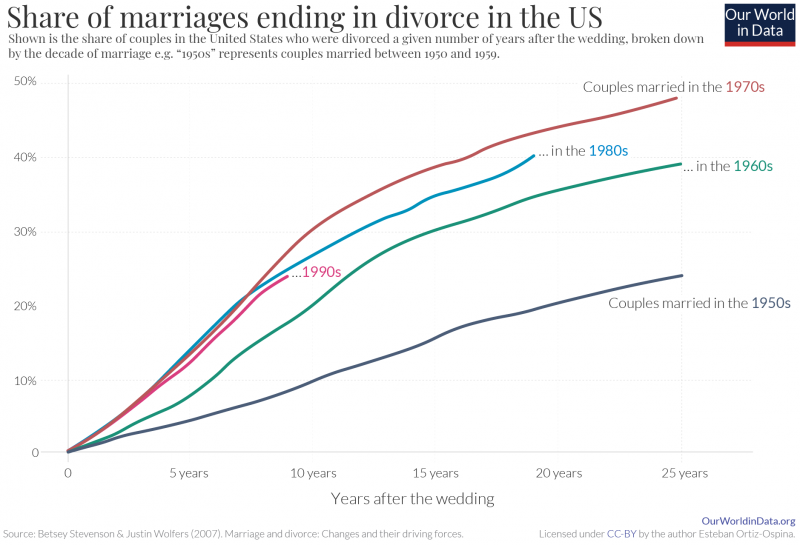
Nosotros see both of these factors in the analysis of divorce rates in the U.s. from Stevenson and Wolfers.15 This chart maps out the percentage of marriages ending in divorce: each line represents the decade they got married (those married in the 1950s, 60s, 70s, 80s and 1990s) and the 10-centrality represents the years since the wedding ceremony.
We see that the share of marriages ending in divorce increased significantly for couples married in 1960s or 70s compared to those who got married in the 1950s. The probability of divorce within 10 years was twice equally high for couples married in the 1960s versus those who got married in the 1950s. For those married in the 1970s, it was more than three times as likely.
Yous might accept heard the popularised claim that "half of marriages end in divorce". We can come across here where that merits might come from – it was once true: 48% of American couples that married in the 1970s were divorced within 25 years.
Just since then the likelihood of divorce has fallen. It fell for couples married in the 1980s, and again for those in the 1990s. Both the likelihood of divorce has been falling, and the length of marriage has been increasing.
Share of marriages ending in divorce in the U.s., past yr of marriage16
This is as well true for marriages in the UK. This chart shows the cumulative share of marriages that ended in divorce: each line represents the year in which couples were married. A useful style to compare unlike age cohorts is past the steepness of the line: steeper lines indicate a faster aggregating of divorces twelvemonth-on-twelvemonth, specially in the before stages of marriages.
You might discover that the divorce curves for couples in the 1960s are shallower and tend to level out in the range of xx% to xxx%. Divorce rates then became increasingly steep throughout the 1970s; 80s and 90s, and somewhen surpass cumulative rates from the 1960s. But, since the 1990s, these curves appear to be falling once again, mirroring the findings from the US.
We don't know even so how long the marriages of younger couples today will final. It will take several decades before nosotros have the total picture on more recent marriages and their eventual outcomes.
Marriages in many countries are getting longer
Equally nosotros saw from information on divorce rates, in some countries – particularly richer countries such every bit the Britain, US and Germany – divorce rates have been falling since the 1990s. This can be partially explained by a reduction in the share of marriages ending in divorce, but likewise by the length of marriages earlier their dissolution.
How has the length of marriages changed over fourth dimension?
In the nautical chart here we see the elapsing of marriages before divorce across a number of countries where this data is available. An important betoken to note hither is that the definitions are not consistent across countries: some countries report the median length of marriage; others the hateful. Since the distribution of spousal relationship lengths is often skewed, the median and hateful values can be quite different. As the United kingdom Part for National Statistics notes:
"The median duration of marriage at divorce in this release is represented past the middle value when the data are bundled in increasing society. The median is used, rather than the hateful, because the elapsing of marriage for divorces is not symmetrically distributed. Therefore, the median provides a more accurate reflection of this distribution. The mean would exist affected by the relatively small number of divorces that take identify when elapsing of marriage exceeds 15 years."
So, nosotros accept to proceed this in listen and be conscientious if we make cross-country comparisons. On the nautical chart shown we note for each country whether the marriage elapsing is given every bit the median or hateful value.
But, we can gain insights for single countries over time. What we see for a number of countries is that the average duration of matrimony before divorce has been increasing since the 1990s or early on 2000s. If we take the UK as an case: marriages got notably shorter betwixt the 1970s to the subsequently 1980s, falling from around 12 to nine years. But, marriages have again increased in length, rise back to over 12 years.
This mirrors what nosotros saw in information on the share of marriages catastrophe in divorce: divorce rates increased significantly between the 1960s/70s through the 1990s, merely have seen a fall since then.
We see a similar pattern in the U.s.a., New Zealand, Australia, and Singapore. However, there is still a significant corporeality of heterogeneity between countries.
Information sources
United nations Globe Marriage Data
- Data: Marital status, marriage rates, and mean historic period of marriage, broken down by sexual activity
- Geographical coverage: Single countries around the world
- Time span: from 1971 onwards
- Available at: Online here.
UN Population Partition
- Data: Household size and composition (including unmarried parent households)
- Geographical coverage: Single countries around the earth
- Time span: from 1960 onwards
- Bachelor at: Online here.
OECD Family Database
- Data: Marital and divorce rates, births outside of matrimony, and cohabitation status
- Geographical coverage: OECD countries only
- Time span: from 1970 onwards
- Available at: Online here.
Eurostat
- Data: Rough wedlock and divorce rates; children born outside of marriage
- Geographical coverage: European countries only
- Time span: from 1960 onwards
- Bachelor at: Online here.
Pew Enquiry Centre
- Data: Policies and legalisation of same-sex activity marriage
- Geographical coverage: Single countries across the world
- Time span: from 2000 onwards
- Available at: Online here.
National Statistical Agencies
Source: https://ourworldindata.org/marriages-and-divorces
0 Response to "Changing Patterns Over Time Clearly Demonstrate That Marriage, Family, and Kinship Are"
Postar um comentário